Fragrance layering: the trend reinventing your scent


Not so long ago, choosing a perfume was like choosing a signature: a single one, worn for months, sometimes for years. Today, a new generation of fragrance lovers is doing exactly the opposite: they layer. It's called layering, and it has become one of the most popular ways to wear perfume, driven by a simple idea: why settle for a ready-made scent when you can compose your own?

By L.T.Piver

Layering isn’t really new

The word may be recent, but the practice is not. Long before social media and the rise of olfactory customization, several cultures already layered scents with great sophistication. In ancient Egyptian temples, different resins were burned depending on the time of day, incense at dawn, myrrh at noon, and a more complex blend at sunset, allowing the surrounding atmosphere to shift with the rhythm of the day. In Gulf Arab and Persian traditions, musk oils have been layered under alcohol-based perfumes for centuries, a practice built on the same principle as today’s layering: a dense, oily base that supports and extends a lighter fragrance applied on top.

What is new, however, is how this practice has moved beyond the circle of connoisseurs to become a mainstream gesture, fueled by the sheer number of fragrances now available, a growing desire for personalization, and online communities sharing their combinations. Layering as we know it in the West, really took off in the 2010s, but its roots run far deeper.
What actually happens when you layer two perfums

Layering two perfumes doesn’t mean mixing them in a single bottle: it means letting two already-finished compositions meet on the skin, carried by the warmth of the body. And contrary to intuition, the brain doesn’t simply add the two scents together. Research in olfactory neuroscience has shown that the piriform cortex, the brain region responsible for processing smell, doesn’t sum two familiar odors when they’re perceived together: it constructs a third perception, distinct from either original scent. In other words, perfume A combined with perfume B doesn’t produce “A plus B,” but rather “C,” an entirely new scent that neither bottle contains on its own.

This is what explains both the promise and the risk of layering: when a combination works, you end up wearing a scent no one else wears in quite the same way. When it doesn’t, the brain mostly registers confusion, a vague sense that “something is off,” without always being able to say why.

Two ways to layer adn there are generally two approaches. The first, same-spot layering, involves applying the fragrances one on top of the other, on the same areas of skin. The two scents then blend into a more unified, hybrid trail. The second, split-point layering, involves applying each fragrance to a different part of the body (one wrist, the nape of the neck, the inside of an elbow). The two scents remain more distinct and interact as you move, creating a shifting, almost dynamic effect. The second method is often recommended for beginners, since it leaves more room for error: if the combination doesn’t quite work, both perfumes remain identifiable on their own rather than merging into one disappointing result.

The simple rules for layering well

A few principles come up again and again, regardless of the source or tradition:

Start light, layer heavier on top. A fresh or citrus fragrance is generally applied before a richer, woodier, or muskier one. Done the other way around, the first scent often gets completely overpowered.

Look for common ground rather than a head-on clash. Two fragrances that share a family or a similar base note (a shared woody accord, a shared amber note) tend to blend well almost every time. Some pairings, on the other hand, are harder to reconcile: a very sharp citrus with a very sweet gourmand, or a strong herbal note with a delicate floral, tend to require more experimentation.

Stick to two fragrances to begin with. Beyond that, it becomes difficult to tell what’s working and what isn’t within the combination. Once the logic feels intuitive, three-way combinations are worth exploring.

Give it time before judging. A layered scent evolves over several hours, just like a single fragrance does. It’s worth wearing a combination for a few hours before forming an opinion, giving the top notes time to fade so the heart, and then the base, can fully reveal themselves.

Test it on your own skin. Skin chemistry has a strong influence on how a combination reads. What looks spectacular on someone else can turn out completely differently on you.

Layering with L.T. Piver fragrances

Our perfumes, designed as light, refreshing fragrances, make excellent bases for layering: they don’t impose their own character and leave room for whatever is layered on top. Here are five combinations worth trying.

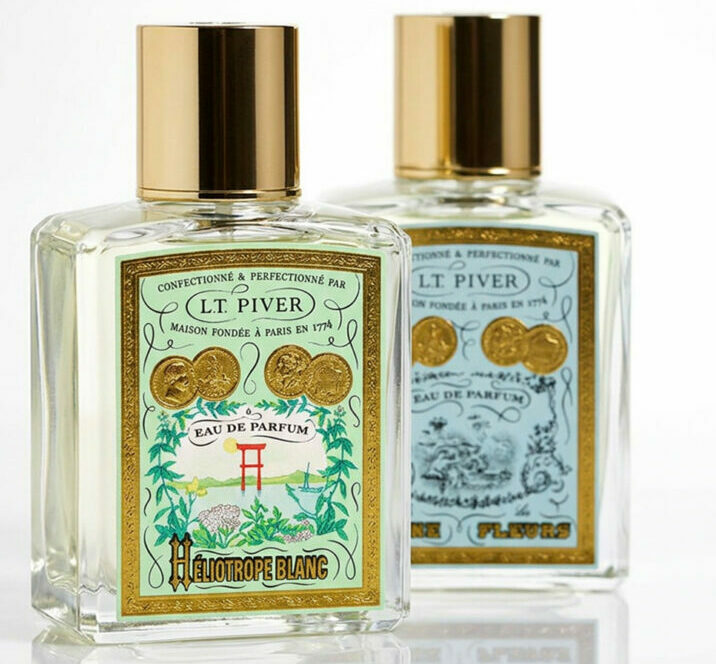
À la Reine des Fleurs + Héliotrope Blanc. Verbena freshness as the base, powdery almond and vanilla roundness layered on top. A gentle contrast between spontaneity and enveloping softness.

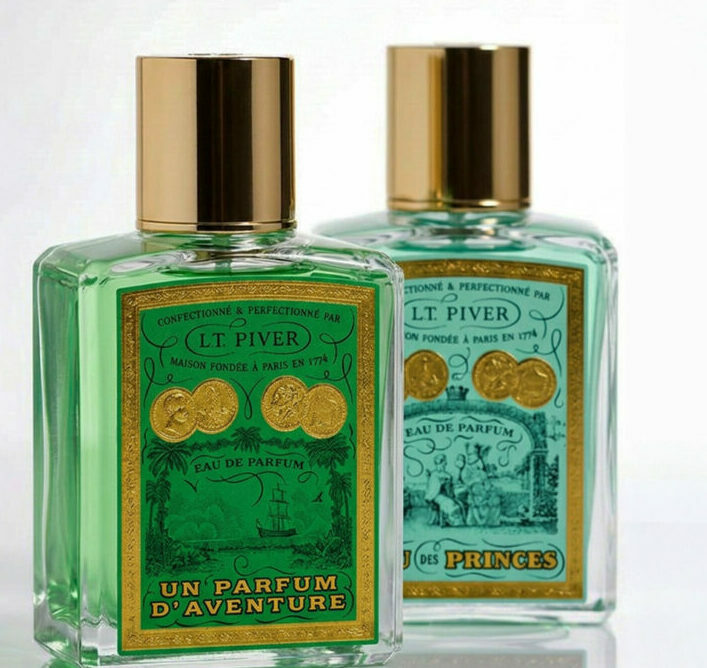
Eau des Princes + Un Parfum d’Aventure. The mentholated freshness of Eau des Princes paves the way for the warm spices of Un Parfum d’Aventure, for a trail that gains depth without losing its liveliness.

Cuir de Russie + À la Reine des Fleurs. Smoky leather at the base anchors the composition, while verbena and orange blossom lighten it, like a ray of freshness resting on a dense material.

Héliotrope Blanc + Un Parfum d’Aventure. The powdery sweetness of one meets the warm spices of the other, for a trail that’s both gourmand and lightly exotic.

Pompeia + Héliotrope Blanc. The juicy peach of Pompeia finds a gourmand echo in the roundness of Héliotrope Blanc, for a pairing as sun-drenched as it is comforting.

There’s no single, definitive combination. That’s precisely what makes layering worthwhile: every attempt tells a slightly different version of you.

Discover our collection of perfumes  and compose your own signature scent.

Perfumes

Personalized Gift

Gift wrapping available with every order.

Customer Service

Our team is here to assist you: contact us by email.

Free Delivery

With any purchase over 55€ to pickup point

Complimentary Sample

Complimentary fragrance sample with purchases of 65€ or more.